
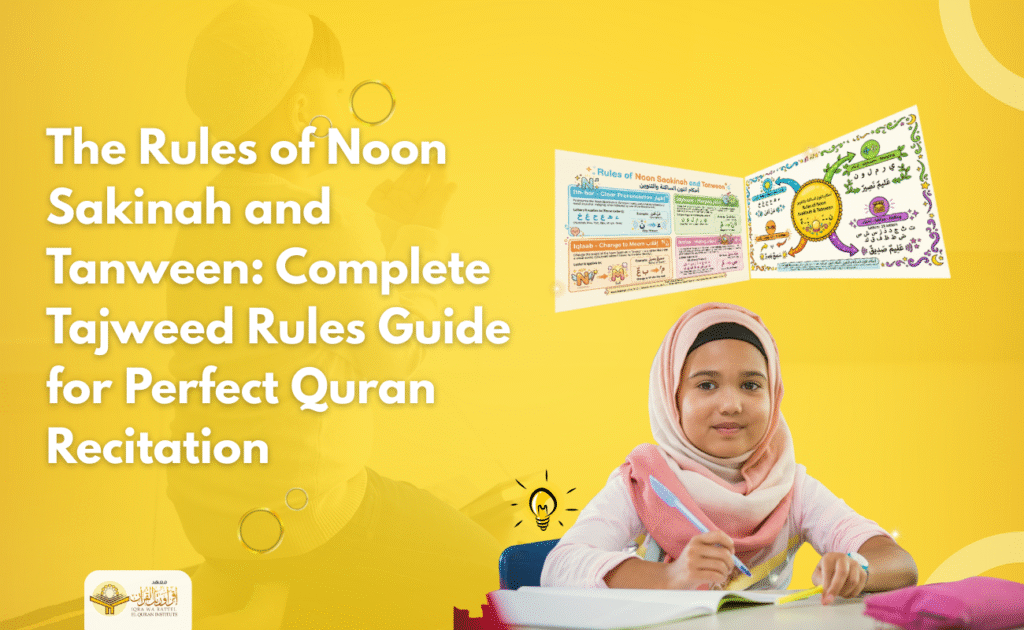
If you have ever listened to a beautiful Quran recitation and wondered why the reciter sometimes pronounces the “n” sound clearly, sometimes hums it through the nose, and sometimes seems to turn it into an “m” — you were hearing the noon sakinah and tanween rules in action. These four rules — Izhar, Idgham, Iqlab, and Ikhfa — govern one of the most frequent sounds in the entire Quran, which is why they are the first major chapter taught in every Tajweed program.
The good news: the system is completely logical. Every rule depends on exactly one thing — the letter that comes immediately after the noon sound. Once you know which letters trigger which rule, you can apply them anywhere in the Quran.
This guide covers all four rules with their letters, pronunciation method, authentic Quranic examples (with full diacritics), the exceptions, and the mistakes English speakers make most often.
What Are Noon Sakinah and Tanween?
Noon sakinah (نْ) is the Arabic letter noon carrying a sukoon (ـْ) — meaning it has no vowel of its own. It can appear in the middle of a word, like مِنْكُمْ (minkum), or at the end, like مِنْ (min). It is a real, written letter of the word.
Tanween (ـً ـٍ ـٌ) is the double vowel mark found at the end of indefinite nouns and adjectives — fathatayn (ـً), kasratayn (ـٍ), or dammatayn (ـٌ). It is not a written letter, but it produces an extra “n” sound in pronunciation: كِتَابٌ is read kitābun.
Why are they taught together?
Because they produce the exact same sound — a noon with sukoon. Since the sound is identical, classical Tajweed scholarship gives them identical rules. Master one and you have mastered both. Two differences worth knowing:
| Noon Sakinah | Tanween | |
|---|---|---|
| Nature | An original letter of the alphabet | A grammatical vowel marker, not a letter |
| Position | Middle or end of a word | Only at the end of nouns/adjectives |
| Written? | Yes, visible in the text | Only as a diacritic |
| When you stop on the word | Still pronounced | Dropped (fathatayn becomes a long “ā”) |
That last row matters in practice: if you pause on عَلِيمًا, you read ʿalīmā — the tanween disappears. The four rules below apply only when you continue reading.
The 4 Rules at a Glance
Everything depends on the next letter. Here is the complete map — bookmark this table:
| Rule | Meaning | Trigger letters | What you do | Ghunnah? |
|---|---|---|---|---|
| 1. Izhar إظهار | Clarity | ء هـ ع ح غ خ (6 throat letters) | Pronounce the noon clearly and quickly | No |
| 2. Idgham إدغام | Merging | ي ر م ل و ن (يرملون) | Merge the noon into the next letter | With ي ن م و only |
| 3. Iqlab إقلاب | Conversion | ب (one letter) | Convert the noon into a hidden meem | Yes, 2 counts |
| 4. Ikhfa إخفاء | Hiding | The remaining 15 letters | Hide the noon between clear and merged | Yes, 2 counts |
Ghunnah is the nasal sound produced entirely through the nose, held for approximately two counts (the time of saying “one-two” at your recitation pace). Now each rule in full.
Rule 1: Izhar (Clear Pronunciation)
Trigger letters — the 6 throat letters: ء، هـ، ع، ح، غ، خ
These letters are pronounced from the throat, far from the noon’s articulation point at the tongue tip. Because the two sounds come from distant places, no blending occurs — so the noon is pronounced clearly, lightly, and without stretching. No ghunnah is held.
| Example | Reference | Type |
|---|---|---|
| أَنْعَمْتَ | Al-Fatihah 1:7 | Noon + ع (within a word) |
| مِنْ خَوْفٍ | Quraysh 106:4 | Noon + خ (across two words) |
| مِنْ غِلٍّ | Al-Hijr 15:47 | Noon + غ |
| عَذَابٌ أَلِيمٌ | Al-Baqarah 2:10 | Tanween + ء |
| عَلِيمٌ حَكِيمٌ | An-Nisa 4:26 | Tanween + ح |
The common error: English speakers often hold the noon too long or add a slight nasal hum out of habit. In Izhar, say the “n” crisply and move on — think of the “n” in “input” said quickly.
Rule 2: Idgham (Merging)
Trigger letters: the six letters gathered in the mnemonic word يَرْمَلُون — ي، ر، م، ل، و، ن.
When noon sakinah or tanween is followed by one of these letters at the start of the next word, the noon disappears and merges into that letter, which is then pronounced doubled (as if it carried a shaddah). Idgham splits into two types:
Idgham with Ghunnah
Letters: ي، ن، م، و — the noon merges into the next letter while keeping the nasal ghunnah for two counts.
| Example | Reference | Read as |
|---|---|---|
| مَن يَقُولُ | Al-Baqarah 2:8 | may-yaqūlu |
| مِن نِّعْمَةٍ | An-Nahl 16:53 | min-niʿmah (doubled ن) |
| مِن مَّاءٍ | An-Nur 24:45 | mim-māʾ |
| مِن وَالٍ | Ar-Ra’d 13:11 | miw-wāl |
| خَيْرًا يَرَهُ | Az-Zalzalah 99:7 | khayray-yarah |
Idgham without Ghunnah
Letters: ل، ر — the merge is complete and instant, with no nasal sound at all.
| Example | Reference | Read as |
|---|---|---|
| مِن رَّبِّهِمْ | Al-Baqarah 2:5 | mir-rabbihim |
| هُدًى لِّلْمُتَّقِينَ | Al-Baqarah 2:2 | hudal-lil-muttaqīn |
| غَفُورٌ رَّحِيمٌ | Frequent, e.g. Al-Baqarah 2:173 | ghafūrur-raḥīm |
The critical exception: Izhar Mutlaq
Idgham only happens across two words. When noon sakinah is followed by و or ي inside the same word, you must pronounce the noon clearly instead. This occurs in exactly four Quranic words:
الدُّنْيَا (ad-dunyā) · بُنْيَانٌ (bunyān) · قِنْوَانٌ (qinwān) · صِنْوَانٌ (ṣinwān)
Merging the noon in these words is a common and serious mistake — the meaning of the word would be lost.
Rule 3: Iqlab (Conversion)
Trigger letter: ب only.
The noon sound and the letter ب are awkward to pronounce in sequence, so the noon is converted into a hidden meem (م), pronounced with ghunnah for two counts, with the lips touching lightly — not pressed. In the mushaf, this rule is marked by a small م written above the noon or tanween.
| Example | Reference | Read as |
|---|---|---|
| مِن بَعْدِ | Al-Baqarah 2:27 | mim-baʿdi |
| أَنبِئْهُم | Al-Baqarah 2:33 | ambiʾhum (within a word) |
| سَمِيعٌ بَصِيرٌ | Al-Hajj 22:75 | samīʿum-baṣīr |
The common error: pressing the lips together firmly as in a normal English “m”. In Iqlab, the lip contact stays light so the ghunnah flows through the nose.
Rule 4: Ikhfa (Hiding)
Trigger letters — the remaining 15: ت، ث، ج، د، ذ، ز، س، ش، ص، ض، ط، ظ، ف، ق، ك
Ikhfa means pronouncing the noon in a state between Izhar and Idgham: the noon itself disappears (your tongue does not touch the articulation point of noon), but a ghunnah of two counts remains, and your mouth prepares for the following letter during the ghunnah.
| Example | Reference | Type |
|---|---|---|
| مِن تَحْتِهَا | Al-Baqarah 2:25 | Noon + ت |
| الْإِنسَانَ | Al-‘Alaq 96:2 | Noon + س (within a word) |
| أَنتُمْ | Frequent, e.g. Al-Baqarah 2:85 | Noon + ت (within a word) |
| عَن صَلَاتِهِمْ | Al-Ma’un 107:5 | Noon + ص |
| رِيحًا صَرْصَرًا | Fussilat 41:16 | Tanween + ص |
A refinement most beginners miss
The ghunnah of Ikhfa takes the “flavor” of the following letter. Before a heavy (tafkheem) letter — ق، ط، ص، ض، ظ — the ghunnah is pronounced full and heavy, as in مِن قَبْلُ. Before light letters, it stays light, as in مِن تَحْتِهَا. This single detail separates an average recitation from a precise one.
The 5 Mistakes English Speakers Make Most
After years of teaching Tajweed to students in the US, UK, Canada, and Australia, our teachers see the same patterns repeatedly:
- Applying Izhar everywhere. English has only one “n” behavior, so beginners default to pronouncing every noon clearly. Result: Idgham and Ikhfa disappear entirely.
- Cutting the ghunnah short. Two counts feels unnaturally long to English speakers. Practice counting it until it becomes automatic.
- Merging the noon in الدُّنْيَا. The Izhar Mutlaq exception is unknown to most self-taught learners.
- Turning Ikhfa into a full “n”. In Ikhfa the tongue must not touch the ridge behind the teeth. If it touches, you have accidentally made Izhar.
- Reading tanween when stopping. Tanween exists only in continuous reading; at a stop, it drops.
Every one of these is invisible to you when you practice alone — and instantly obvious to a trained teacher. This is why the noon sakinah chapter, more than any other, benefits from live correction.
How to Practice These Rules
- Learn the letter groups first. Memorize the 6 throat letters and يرملون; everything not in those lists (except ب) is Ikhfa.
- Drill with Surah Al-Baqarah’s opening pages. The first two pages alone contain Idgham (هُدًى لِّلْمُتَّقِينَ), Ikhfa (مِن تَحْتِهَا), Izhar (عَذَابٌ أَلِيمٌ), and Iqlab (مِن بَعْدِ) — a complete workout.
- Listen, then shadow. Play a slow, clear reciter and repeat each verse imitating the noon behavior exactly.
- Recite to a teacher weekly. Tajweed is an oral science transmitted by correction, not by reading alone — our online Tajweed classes are built exactly around this.
Once you are confident with these four rules, the natural next chapter is the rules of meem sakinah — which mirror this system with only three rules. And if you are wondering about the bigger picture, see how long it takes to learn Tajweed.
Frequently Asked Questions
What are the 4 rules of noon sakinah and tanween?
Izhar (clear pronunciation before the 6 throat letters), Idgham (merging before ي ر م ل و ن), Iqlab (converting to meem before ب), and Ikhfa (hiding with ghunnah before the remaining 15 letters).
What is the difference between noon sakinah and tanween?
Noon sakinah is a written letter that can appear mid-word or at the end of any word type; tanween is a vowel marker found only at the end of indefinite nouns. Both produce the same sound and follow the same rules, but tanween is dropped when you stop on the word.
What is ghunnah and how long should it be?
Ghunnah is the nasal sound produced through the nose. In Idgham (with ي ن م و), Iqlab, and Ikhfa, it is held for approximately two counts.
Why is there no Idgham in the word dunya (الدُّنْيَا)?
Because Idgham only applies across two words. When noon sakinah meets و or ي inside the same word — in الدنيا، بنيان، قنوان، صنوان — it is pronounced clearly. This is called Izhar Mutlaq.
How is Iqlab marked in the mushaf?
By a small meem (م) written above the noon sakinah or in place of the second tanween mark.
Can I learn noon sakinah and tanween rules on my own?
You can memorize the letter groups on your own, but correct pronunciation — especially Ikhfa and ghunnah length — requires a qualified teacher listening to you and correcting in real time.
Learn These Rules with a Certified Teacher
Reading about Ikhfa and actually producing it correctly are two different things. At Iqra Wa Rattel Institute, our Ijazah-certified teachers take you (or your child) through every rule in this article with live recitation and instant correction — in one-on-one online classes scheduled around your time zone.
Hear the difference in your own recitation from the first lesson — book your free trial class today.