

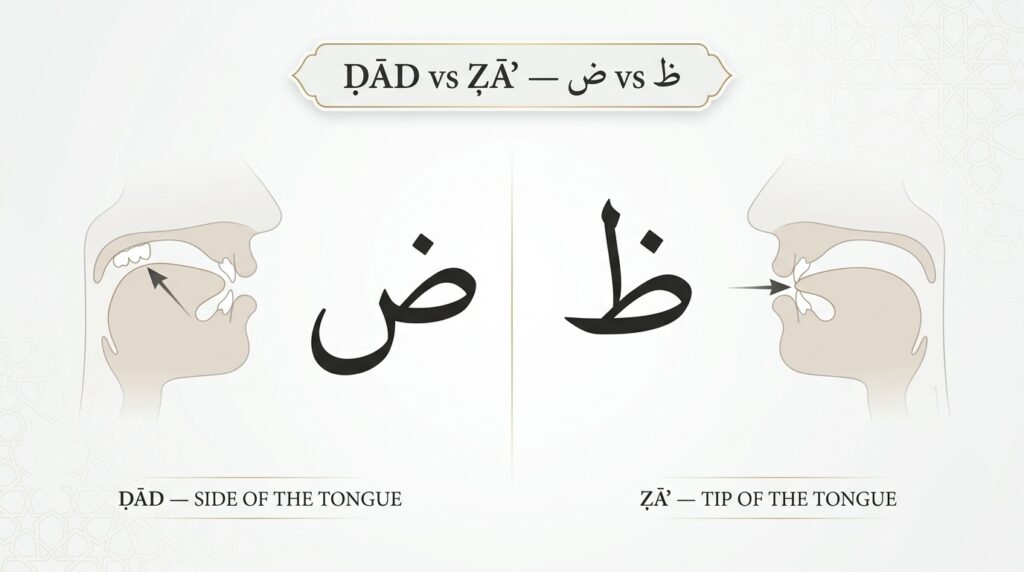
Dhad vs Zha (ض vs ظ) is one of the most common points of confusion for anyone learning to read the Qur’an in Arabic.
Some Arabic letters are much harder to pronounce than others, and these two are especially easy to mix up: Dhad (ض) and Zha (ظ).
They are both heavy letters, and their sounds may seem similar to a non-Arabic speaker. But they are not the same letter, and their articulation points are different.
The good news is that there is a simple way to remember the difference:
Dhad (ض) comes from the side of the tongue. Zha (ظ) comes from the tip of the tongue.
Once you understand where each letter comes from, the difference becomes much easier to recognize and practice.
In this guide, we will explain the difference between Dhad and Zha, their articulation points, their characteristics, common pronunciation mistakes, and a simple technique to help you avoid confusing them when reading the Qur’an.
The One-Minute Trick: Side vs Tip
Here is the easiest way to remember the difference.
Dhad (ض) = SIDE
Think:
Side of the tongue → upper molars
Zha (ظ) = TIP
Think:
Tip of the tongue → upper front teeth
So remember:
SIDE = DHAD
TIP = ZHA
This simple trick can help you quickly identify which part of the tongue you should use.
Dhad (ض) vs Zha (ظ): What Is the Difference?
Feature | ض (Dhad) | ظ (Zha) |
Makhraj (articulation point) | Side edge of tongue against upper back molars | Tip of tongue between upper and lower front teeth (interdental) |
Sifaat (key characteristics) | Voiced (majhūr), Heavy (mufakhkham), Istitalah (sound travels along tongue edge—unique to ض) | Voiced (majhūr), Heavy (mufakhkham) |
Common English mispronunciation | Replaced with plain “d” (د) or merged into ظ | Replaced with “z” or light “th” (ذ) without heaviness |
Quranic minimal pair (Madinah Mushaf) | الضَّالِّينَ (Al-Fātiḥah 1:7) — “those who go astray” | الظَّالِمِينَ (e.g., Al-Baqarah 2:257) — “those who wrong themselves” |
The most important difference is the makhraj, or articulation point.
Dhad (ض)
Dhad comes from the side of the tongue, specifically the side that touches the upper molars.
Zha (ظ)
Zha comes from the tip of the tongue and the edges of the upper front teeth.
So remember:
Dhad = side of the tongue
Zha = tip of the tongue
This is the key difference you should remember when practicing ض vs ظ.
How to Pronounce Dhad (ض) Correctly
The letter Dhad is often considered one of the most difficult Arabic letters, especially for students who are not native Arabic speakers.
Imam Ibn al-Jazari رحمه الله says in Al-Muqaddimah Al-Jazariyyah:
وَالضَّادُ مِنْ حَافَتِهِ إِذْ وَلِيَا
لِأَضْرَاسِ مِنْ أَيْسَرَ أَوْ يُمْنَاهَا
The meaning is that Dhad comes from the side of the tongue next to the molars.
It is most commonly pronounced from the left side, although it can also be pronounced from the right side.
In some cases, both sides may be involved, but this is less common and more difficult.
The Makhraj of Dhad (ض)
The main articulation area of Dhad is:
The side of the tongue touching the upper molars.
When pronouncing a sākin (ض) Dhad, the side of the tongue rises toward the upper mouth.
The part of the tongue near the molars makes stronger contact and pressure, while the rest of the tongue adjusts naturally.
Air from the lungs builds up behind the tongue.
This pressure causes the front part of the tongue to move slightly forward.
The movement is very small.
The tongue moves forward until it reaches the area near where the gum meets the teeth.
This is an important part of understanding the pronunciation of (ض) Dhad.
How to Pronounce Sākin Dhad (ضْ)
Let’s break the movement down into simple steps.

Step 1: Raise the Side of the Tongue
Raise the side of the tongue toward the upper molars.
The side of the tongue makes contact with the upper gum.
You do not need to force every part of the tongue into position. When the correct part of the tongue rises, the rest will naturally adjust.

Step 2: Allow the air to Build Up
The air comes from the lungs and moves into the mouth.
Because the tongue is making contact with the upper mouth, the air cannot simply escape through the middle.
The air pressure begins to build behind the tongue.
Step 3: Allow the Tongue to Move Slightly Forward
The pressure of the air causes the front part of the tongue to move slightly forward.
This movement should happen naturally.
Do not force the tongue forward.

Step 4: Stop at the Correct Point
The tongue should not move too far forward.
When the tip reaches the area where the gum meets the teeth, the movement should stop.
If the tongue moves too far forward, the pronunciation may become closer to Zha.
This is one of the most important points when learning Dhad vs Zha.

Where Does the Air Come Out?
When pronouncing Dhad, the compressed air is released from the area around the side of the tongue.
The amount of air should be controlled.
It should not be too weak, because weak air may not produce the correct movement.
It should also not be too strong, because excessive pressure can push the tongue too quickly.
The goal is natural, controlled pressure.

How to Pronounce Moving Dhad
When Dhad has a vowel, such as:
ضَ — ضِ — ضُ
the tongue movement is different from a completely sākin Dhad.
The tongue separates from the articulation area.
The separation begins from the side of the tongue near the molars.
This may happen on the right side, the left side, or both sides.
Then the rest of the tongue separates from the upper mouth.
The compressed air is released, producing the moving Dhad.
Another Important Difference: Dhad Is Not Just a “Heavy D”
Many beginners are told that Dhad is a heavy D sound.
This may be useful as a very rough starting point, but it is not enough to learn the correct pronunciation.
The most important thing is not simply making the sound heavy.
You need to learn the correct makhraj.
For Dhad:
Focus on the side of the tongue near the upper molars.
For Zha:
Focus on the tip of the tongue with the upper front teeth.
This is why learning Tajweed through listening and correction is so important.
Common Mistakes With Dhad
1. Moving the Tongue Too Far Forward
If the tongue moves too far toward the front teeth, the sound may become closer to Zha.
Remember:
Dhad = side of the tongue.
2. Making Dhad Too Complicated
Some students become so worried about Dhad that they exaggerate the sound.
They may:
press the tongue too strongly,
use too much air,
move the jaw unnecessarily,
or make the sound unnatural.
Correct Tajweed does not require exaggeration.
The goal is a clear and natural pronunciation.
3. Using Too Much Air
Strong air does not automatically mean correct Dhad.
The air pressure should be controlled and natural.
Too much pressure can make the tongue move too quickly and may prevent the letter from taking its proper time.
4. Learning the Letter Only From a Book
A book can explain the articulation point, but pronunciation is a practical skill.
This is especially true for Dhad.
Imam Ibn al-Jazari رحمه الله emphasized the importance of training the tongue and repeating a pronunciation learned directly from a skilled teacher.
Practice is essential.
How to Pronounce Zha (ظ) Correctly
To understand the difference between the two letters, let’s first look at the articulation point and characteristics of Zha (ظ).

The Makhraj of Zha (ظ)
One way to find the articulation point of a letter is to make it sākin and place a hamzat al-waṣl before it.
For example: أَظْ
When you pronounce the sound, the point where the sound stops or is formed helps identify its articulation point.
The letter Zha (ظ) comes from:
the tip of the tongue and the edges of the upper front teeth.
The tongue comes slightly out of the mouth when pronouncing it.
This articulation point is relatively close to the outside of the mouth.
Imam Ibn al-Jazari رحمه الله said:
وَالظَّاءُ وَالذَّالُ وَثَا لِلْعُلْيَا
مِنْ طَرَفَيْهِمَا
This means that Zha, Dhāl, and Thā’ are pronounced from the tip of the tongue with the upper front teeth.
Why Is Zha Called a “Lissānī” Letter?
The letter Zha is classified among the ḥurūf lathawiyyah.
The word refers to the gums, because the articulation of these letters is close to the gum area where the upper front teeth grow.
The sound does not come directly from the gum itself, but from the tongue and upper teeth in that area.
The Five Characteristics of Zha (ظ)
The letter Zha has five main characteristics.
1. Jahr — Voiced
Jahr means that the breath does not continue to flow freely when the letter is pronounced.
The vocal cords vibrate, which prevents the sound from being completely breathy.
Therefore, when you pronounce Zha, make sure that you do not turn it into a breathy or whispered sound.
Common mistake:
A student may pronounce Zha with too much breath, especially when it has a fatḥah.
The correct pronunciation requires Jahr.
2. Iṭbāq — Enclosure
Iṭbāq means that the sound is enclosed between the tongue and the upper palate.
This gives the letter its heavy quality.
This characteristic is especially important because it helps distinguish Zha from Dhāl (ذ).
If Zha did not have Iṭbāq, it would become much closer to Dhāl.
So when pronouncing Zha, do not make it a light sound.
3. Istiʿlā’ — Elevation
Istiʿlā’ means that the back part of the tongue rises toward the upper palate.
This is another reason why Zha is pronounced as a heavy letter.
4. Rikhāwah — Continuity of Sound
Rikhāwah means that the sound can continue to flow while the letter is being pronounced.
Zha is not a strong stop like the letters that have the characteristic of Shiddah.
Therefore, when Zha is sākin, the reader should give it its proper amount of time.
5. Iṣmāt
The fifth characteristic is Iṣmāt.
This is a linguistic characteristic related to the structure of Arabic words. It does not directly make the letter stronger or weaker during pronunciation.
Why Is Zha Considered a Strong Letter?
Zha is one of the strong Arabic letters because several strong characteristics come together in it.
In particular, it has:
Jahr
Iṭbāq
Istiʿlā’
and other characteristics that give it its distinct sound.
Therefore, the reader should pronounce it clearly without making it weak or changing it into another letter.
Important Pronunciation Warnings for Zha
Now let’s look at some of the most common mistakes students make when pronouncing ظ.
1. Do Not Whisper Zha
Be careful not to make Zha breathy or whispered, especially when it has a fatḥah.
Remember:
Zha has Jahr.
The voice should be present when you pronounce it.
2. Do Not Make Zha (ظَ) Light Like Dhāl (ذ)
One of the most common mistakes is to pronounce Zha as if it were a pure Dhāl (ذ).
For example:
مَحْظُورًا
should not be pronounced as though it were:
مَحْذُورًا
The two letters have a similar articulation area, but Zha has Iṭbāq, which gives it its heavy quality.
A useful way to remember this is:
Without Iṭbāq, Zha would become closer to Dhāl.
So make sure the tongue and mouth maintain the correct heavy quality.
Dhad (ض) vs Zha (ظ): The One-Minute Trick
Now we come to the easiest way to remember the difference.
When you see:
ض — Dhad
Think:
SIDE
The side of the tongue moves toward the upper molars.
ظ — Zha
Think:
TIP
The tip of the tongue comes toward the upper front teeth.
So:
ض = side of the tongue
ظ = tip of the tongue
This simple tongue-position trick can help you stop confusing Dhad and Zha.
What About Zha When It Is Sākin?
There are also important points to remember when Zha is sākin.
Zha Followed by Tā’
If a sākin Zha is followed by Tā’, the reader should make the Zha clear and give it its proper time of Rikhāwah before moving to the Tā’.
An example is:
أَوَعَظْتَ
The reader should not rush from Zha directly into Tā’.
Zha Followed by Nūn
When a sākin Zha is followed by Nūn, the reader must also preserve the Rikhāwah of the Zha.
For example:
وَحَفِظْنَاهَا
The Zha should be pronounced clearly.
If the sound is not given its proper time, it may become unclear and get too close to the following Nūn.
Be Careful With a Mushaddad Zha
When Zha has a shaddah, be careful not to confuse it with Dhad.
For example:
الظُّلَّة
الظَّالِم
The Zha should remain clearly recognizable as Zha.
Do not change its articulation point simply because the letter is heavy or has a shaddah.
Examples of the Letter Zha (ظ) in the Qur’an
The Arabic letter Zha (ظ) is an important letter in Qur’anic Arabic. It appears in many words with different meanings, such as الظُّلْم (injustice), الظَّنّ (assumption), الظِّلّ (shade), and الظُّلُمَات (darknesses). Learning to recognize the letter (ظ) in different words can help you improve both your Arabic pronunciation and your Qur’an recitation. The table below provides examples of Qur’anic words containing (ظ), together with their English meanings and the reported number of occurrences.
| No. | Arabic Word | Meaning / English Reference | Occurrences |
|---|---|---|---|
| 1 | الظُّلْم | Injustice / wrongdoing | 289 |
| 2 | النَّظَر | Looking / seeing | 129 |
| 3 | عَظِيم | Great / عظیم | 113 |
| 4 | الظَّنّ | Assumption / suspicion | 69 |
| 5 | الظَّاهِر | The apparent / manifest | 57 |
| 6 | الْحِفْظ | Preservation / protection | 44 |
| 7 | الظُّلُمَات | Darknesses | 26 |
| 8 | الْمَوْعِظَة | Admonition / reminder | 25 |
| 9 | الظِّلّ | Shade | 24 |
| 10 | الْعِظَام | Bones | 15 |
| 11 | غِلْظ | Harshness / severity | 13 |
| 12 | الْغَيْظ | Anger / rage | 11 |
| 13 | فَظَلُّوا | So they remained | 9 |
| 14 | الْحَظّ | Share / portion | 7 |
| 15 | كَظِيم | Restrained in grief / sorrowful | 6 |
| 16 | الظَّمَأ | Thirst | 3 |
| 17 | لَظَى | A name of Hellfire | 2 |
| 18 | الظَّهِيرَة | Midday | 2 |
| 19 | ظُفُر | Fingernail / claw | 1 |
| 20 | أَظْفَرَكُمْ | He gave you victory | 1 |
| 21 | شُوَاظ | Flame / blaze | 1 |
| 22 | الْمُحْتَظِر | One who builds an enclosure | 1 |
| 23 | أَيْقَاظًا | Awake | 1 |
| 24 | فَظًّا | Harsh / rough | 1 |
| 25 | مَحْظُورًا | Forbidden / restricted | 1 |
| 26 | ظَعْنُكُمْ | Your travel / departure | 1 |
| 27 | يَلْفِظ | Utters / spits out | 1 |
A Simple Practice Method for ض vs ظ
If you often confuse these two letters, try this short exercise.
Step 1 — Say the articulation point
For ض, think:
Side of the tongue → upper molars
For ظ, think:
Tip of the tongue → upper front teeth
Step 2 — Practice the letters separately
Practice:
ضَ — ضِ — ضُ
Then:
ظَ — ظِ — ظُ
Step 3 — Compare them
Move your tongue carefully and notice the difference.
Do not try to make both sounds simply “heavy.”
Focus on where the tongue is working.
Step 4 — Practice Qur’anic words
Practice words containing Dhad and Zha and ask a qualified teacher to correct you.
Step 5 — Repeat
Pronunciation becomes easier through repetition. You do not need to master the letter in one lesson.
That simple difference can help you stop confusing these two letters.
With regular practice and correction from a qualified Qur’an teacher, the pronunciation of both letters can become much more natural.
May Allah help us recite the Qur’an correctly, beautifully, and with understanding.
Allahumma ameen.
Learn Qur’an and Tajweed With a Qualified Teacher
If you or your child is struggling with Dhad, Zha, or other difficult Arabic letters, learning directly from a qualified Qur’an teacher can make the process much easier.
At Iqra Wa Rattel Institute, students can learn Qur’an reading, Tajweed, Arabic, and Islamic Studies through online lessons with qualified teachers.
Book a free trial lesson and let us help you build correct Qur’an pronunciation step by step.