
Finding the right online Quran teacher for children is one of the most important decisions a Muslim parent can make today. Many families in the United States, Canada, the United Kingdom, Europe, and Australia want their children to build a strong relationship with the Quran, but they also need classes that fit modern family life. Parents want a teacher who is kind, reliable, skilled in Tajweed, and able to connect with children in English.
The problem is that almost every academy online says the same thing. Every website promises “qualified teachers,” “one-on-one attention,” and “flexible scheduling.” So how do you actually tell a genuinely excellent teacher from a well-marketed average one?
This guide is different. Instead of listing qualities you already know to look for, it gives you the practical tools parents rarely get: how to verify an Ijazah with your own eyes, what a real progress report should contain, the warning signs of a weak academy, honest pricing you can expect to pay, and the exact questions to ask before you book. By the end, you will be able to judge any online Quran teacher with confidence.
Why Online Quran Learning Has Become the Practical Choice
For many families, online Quran education is no longer a second choice. It has become the practical one. Parents are busy, children have school and activities, and in many cities it is simply hard to find a local teacher who is qualified, child-friendly, and available at the right time.
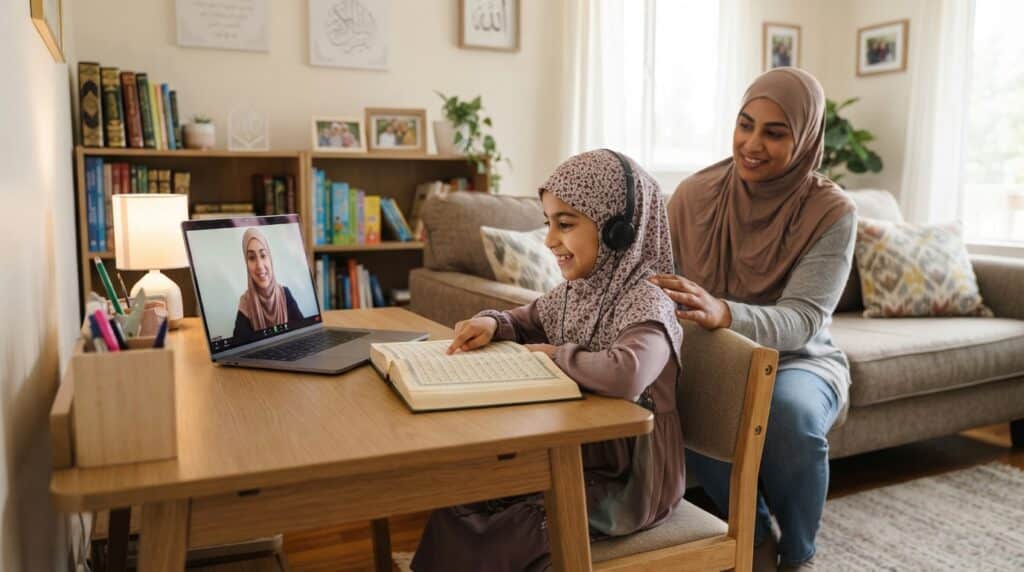
Online learning solves this by opening the door to teachers you would never reach locally. Instead of choosing from one nearby option, you can find a teacher with the right teaching style, English fluency, and Quranic training — including a female Quran teacher for kids, a specialist in Tajweed, or someone patient with shy beginners. It also lets your child learn in the calm and safety of home, which often helps young learners focus better than an unfamiliar classroom.
But this wider choice raises the real question of this article: with so many options, how do you know which teacher is truly right for your child?
Online vs Local Quran Classes: An Honest Comparison
Before choosing a teacher, it helps to be honest about the trade-offs. Online learning is excellent for most families, but it is not automatically better in every way. Here is a fair breakdown.
| Factor | Local / Mosque Classes | Online One-on-One Classes |
|---|---|---|
| Teacher choice | Limited to who is nearby | Access to specialists worldwide |
| Attention per child | Often group-based, shared | Fully personal, one-on-one |
| Scheduling | Fixed times, travel required | Flexible, fits around school & time zones |
| English support | Varies; may be Arabic/Urdu only | Teachers fluent in English available |
| Female teacher option | Not always available | Widely available |
| Progress tracking | Informal, often verbal | Structured written reports (with good academies) |
| Social interaction | Strong — kids learn together | Weaker — needs a warm teacher to compensate |
| Requires | Just showing up | Reliable internet, a device, a quiet space |
The honest takeaway: online classes win clearly on teacher quality, personal attention, and flexibility. Where they need a good academy to make up ground is in engagement and social connection — which is exactly why the teacher you choose matters more than the platform.
The 5 Signs of a Truly Great Online Quran Teacher for Children
The best online Quran teacher for kids is not simply someone who recites beautifully. Reciting well and teaching children well are two very different skills. Here are the five signs that matter most.
1. Patience that never embarrasses the child
Children repeat, forget, and get distracted — that is normal. A great teacher stays calm, never shames a child for mistakes, and understands that love of the Quran grows in a patient environment. In my experience, parents focus first on qualifications, which is right — but for children, patience is what makes those qualifications useful. A highly knowledgeable teacher who lacks gentleness can slow a child down rather than help.
2. Real Tajweed expertise from the start
Children should learn correct recitation early, not perfectly on day one, but consistently guided. Strong Tajweed helps a child pronounce Arabic letters correctly, distinguish similar sounds, build confidence, and — crucially — avoid mistakes becoming permanent habits. This is why Quran lessons for beginners should never be random.
3. A child-friendly teaching style
A teacher can be excellent with adults and still not right for a six-year-old. Look for someone who keeps explanations short, uses praise wisely, notices when a child is tired, switches methods when needed, and makes the child feel safe enough to try. Children don’t need a lecture — they need encouraging, guided teaching that keeps them genuinely engaged with questions, gentle challenges, and small wins.
4. Clear English and strong parent communication
For families in the West, English fluency removes confusion for the child and lets you, the parent, discuss goals and progress easily. This matters especially for revert families and homes where Arabic isn’t spoken. The best teachers also keep you updated on what your child learned, what needs practice, and what comes next — you should never be left guessing.
5. Genuine experience with young learners
Teaching a five-year-old is nothing like teaching a twelve-year-old. An experienced children’s teacher knows when to use repetition, when to pause, when to add a simple game, and when to reduce pressure — and always leads with encouragement before correction.
How to Actually Verify a Teacher’s Ijazah (Not Just Take Their Word for It)
Almost every online academy will tell you their teachers are “qualified” or “Ijazah-certified.” But very few parents know what that actually means, or how to check it. An Ijazah is a formal certification that a teacher has recited the entire Quran to a qualified scholar who confirmed their recitation is accurate, and granted them permission to teach it to others. What makes it powerful is the Sanad — an unbroken chain of teachers that, in an authentic Ijazah, traces all the way back to the Prophet ﷺ.
So how do you verify it’s real? Here’s exactly what to do:
1. Ask to see the actual certificate. A genuine teacher will be happy to show it. It should be a formal document, usually in Arabic, containing the teacher’s full name, the name of the sheikh who granted it, the Riwayah they’re certified in (most commonly Hafs ‘an Asim), and an official seal or signature. If a teacher hesitates or can’t produce anything, that’s your first red flag.
2. Look for the chain of transmission (Sanad). A real Ijazah lists the names of teachers in sequence — this teacher learned from that sheikh, who learned from another, and so on. This chain is the heart of the certification. A certificate with no listed chain is just a decorative paper. Here’s a practical tip: take the second or third name after the teacher’s in the chain and search for it online. This often leads you to information or videos about the teacher’s sheikh, which can help you judge how established and reputable that chain really is.
3. Confirm the type of Ijazah. There’s a difference between an Ijazah in recitation (the teacher recites correctly with Tajweed) and an Ijazah in memorization (they’ve memorized the full Quran with a chain). If you specifically want a Hifz teacher for your child, ask which one they hold.
4. Check the seal and the granting institution. Authentic certificates carry the stamp or seal of the sheikh or institution that issued them. A serious academy will tell you openly where their teachers were certified.
5. Ask how the Ijazah was earned: face-to-face or over the phone?
This is one of the most important questions today — and almost no parent thinks to ask it. In recent years, some teachers have obtained their Ijazah by reciting to their sheikh over phone or audio calls, without the sheikh ever seeing their mouth and lips as they recite. This matters more than it sounds. Correct recitation depends heavily on articulation points (makharij) — the precise movements of the tongue, lips, and mouth. A sheikh who can only hear a voice, and not watch how the sounds are formed, cannot fully correct these fine details. Add the occasional dropped audio or connection glitch, and small errors can slip through unnoticed. An Ijazah earned face-to-face (in person, or at minimum over clear live video) is far more reliable than one earned by voice alone. Don’t hesitate to ask: “Did you receive your Ijazah in person with your sheikh, or over the phone?”
6. Ask a few honest follow-up questions. You don’t need to be an Arabic scholar to test sincerity. A confident, certified teacher answers these instantly and openly, while vagueness is a warning sign:
- “Who did you receive your Ijazah from, and in which Riwayah?”
- “Is this your only Ijazah, or do you hold others?”
- “How long did it take you to earn your Ijazah?” — a serious Ijazah takes real years of study, not a few months.
- “Is your sheikh well-known and trusted (mashhūd lahu bil-‘adl) in this field?”
- “Have you granted an Ijazah to any student before, or would my child be among your first?”
Here at Iqra Wa Rattel Institute, we don’t ask parents to simply trust us. Below is an example of a real Ijazah held by one of our teachers, complete with the official seal and chain of transmission — exactly the kind of document you should expect to see before enrolling your child anywhere.
A Real Ijazah From One of Our Teachers
Complete with the official seal and an unbroken chain of transmission (Sanad) back to the Prophet ﷺ — issued in the recitation of Hafs 'an Asim, via the Shatibiyyah. This is exactly the kind of document you should expect to see before enrolling your child anywhere. (The teacher's personal name has been hidden for privacy.)


You have every right to ask — and a trustworthy teacher has nothing to hide.
What a Good Progress Report Actually Looks Like
One of the biggest frustrations parents describe is enrolling their child in Quran classes and then having no idea whether real learning is happening. Weeks pass, payments are made, and yet no one can answer a basic question: is my child actually improving?
A serious program removes that guesswork. Good communication isn’t a monthly “he’s doing great” message — it’s a structured progress report that shows parents exactly where their child stands and where they’re heading.
So what should a proper progress report include?
Clear milestones, not vague praise. A useful report tracks specific, measurable things: which letters or Noorani Qaida lessons are complete, which Surahs have been memorized, which Tajweed rules the child has learned and applied, and how reading fluency is developing over time.
Both strengths and areas to work on. Honest reporting builds trust. A good teacher tells you not only what your child does well, but also what needs practice — and what you can reinforce at home between lessons.
A sense of direction. The best reports don’t just describe the past; they set the next goal: “This month we completed Juz’ ‘Amma; next we’ll begin revision alongside new memorization.” That tells you there’s a real plan, not random pages.
Consistency over time. One report means little. A pattern of regular updates — even short ones — shows a child is on a steady, accountable path rather than drifting.
But the strongest proof of all isn’t a document — it’s a child who has actually completed the journey. Below is a video of one of our students celebrating his Khatm (completion of the Quran) alongside his sibling and their teacher, followed by a real sample progress report and a short review from the child’s parent. This is what genuine, trackable progress looks like in practice.
Listen to Haytham: A Young Hafiz in His Own Words
Numbers and certificates tell one story — but a child's own heart tells another. In this short audio, listen to Haytham, one of our students, just after he recited the very last words of his Quran journey with his teacher.
“Like… my heart was beating.” — Haytham, on reading his final page
In an honest and touching conversation, he opens up about what the journey really felt like: the days he felt bored or wanted to give up, the moment his older sibling finished before him and how he handled those feelings, and how his heart raced as he approached his last page. Most of all, he shares the quiet joy he feels now that he has completed the Book of Allah.
To protect our student's privacy, this is shared as audio over Quran visuals — his voice, his real words.
Every child's path has hard days. The right teacher is the one who walks through them with your child — until moments like this one.
When you’re evaluating any online Quran teacher for your child, ask directly: “How will you show me my child’s progress?” The answer — and whether they can back it up with real examples like these — tells you almost everything you need to know.
Red Flags of a Weak Online Quran Academy
Choosing a teacher is also about avoiding the wrong academy. These are the warning signs parents rarely hear about openly — but should:
- Teachers change without warning. If your child bonds with a teacher and is suddenly reassigned to a stranger, progress and trust both break. Ask upfront whether your child keeps the same teacher.
- “One-on-one” that quietly becomes a group. Some academies advertise private classes, then place several children in one session. Confirm in writing that classes are truly individual.
- No trial lesson, or pressure to pay first. A confident academy lets you observe before committing. Heavy pressure to pay immediately is a warning sign.
- No makeup-class or cancellation policy. Life happens. If there’s no clear policy for missed classes, you’ll lose money and momentum.
- Vague answers about qualifications. If they can’t clearly say who certified their teachers, treat “qualified” as marketing, not fact.
- No student dashboard — everything runs on WhatsApp. If the academy has no proper platform or student portal to track lessons, attendance, and progress, and instead manages everything through casual WhatsApp messages, that’s a sign of a disorganized operation. A serious academy gives you a real system where you can see your child’s journey, not scattered chat messages.
- No academic quality supervision. Ask whether a supervisor ever sits in on lessons to observe the teacher and student together and evaluate the quality of teaching. Academies without this oversight have no way of knowing whether their teachers are actually effective — you’re simply left to hope.
- No clear curriculum. If the academy can’t show you a structured syllabus — what your child learns first, what comes next, and how it builds — then lessons will be random and progress will stall. A real program follows a defined path, not improvisation.
- No structured progress updates. If the only feedback is a casual “she’s doing well,” there’s likely no real system tracking your child.
- No clear, time-bound goals. A trustworthy academy sets concrete milestones with dates: “Within two months your child will finish this level; within the next month they’ll reach this point; then we move on to the next stage.” If all you get are vague promises with no roadmap, there’s no real plan behind the teaching.
- Price that seems too good to be true. Extremely cheap rates often mean overloaded teachers, large groups, or high turnover.
A note of caution: don’t be won over by a polished Facebook ad or a single beautiful video. That’s the best thing they have — of course they’ll show it to you. Be smart, and judge an academy by the questions above, not by its marketing. A good academy will pass every one of these without hesitation. If you feel resistance when you ask, listen to that feeling.
How Much Should Online Quran Classes Cost?
Pricing is one of the things parents most want to know and least like to ask. Here is an honest picture of the current market so you can judge value fairly.
For standard one-on-one Quran classes for children, typical rates in 2026 look roughly like this:
- United States & Canada: around $20–$50 per month for a common plan of about 2–5 short lessons per week.
- United Kingdom: around £25–£60 per month for similar frequency.
- Standard lesson length: about 30 minutes, which suits most children’s attention spans. Longer or intensive Hifz (memorization) classes often run an hour and usually cost more.
What actually moves the price up or down:
- One-on-one vs group: private lessons cost more but give far more reading time and correction — usually worth it for children.
- Number of weekly classes: more sessions per week means a higher monthly total, but faster progress.
- Teacher specialization: an Ijazah-holding Hifz specialist typically costs more than a general reading tutor.
- Session length: a 30-minute class and a 60-minute Hifz session are priced differently.
A useful rule: don’t choose on price alone. The cheapest option is rarely the best value if your child doesn’t connect with the teacher or the “private” class turns out to be a crowded group. Look at what you get for the fee — real one-on-one time, a qualified teacher, and proper progress reports.
You can see our current plans on the pricing page, and the best way to judge value is to book a free trial and experience the teaching before you decide.
The Questions to Ask Before You Book (Parent Checklist)
When you speak to any academy or teacher, these are the questions that reveal the truth quickly. Ask them directly — a good teacher welcomes them.
About the teacher
- Do you have experience teaching children of my child’s age?
- Are you fluent in English?
- How do you handle shy or easily distracted students?
- Who granted your Ijazah, and in which Riwayah?
About the class format
- Are lessons genuinely one-on-one, or group-based?
- How long is each class, and how often should my child attend?
- Will my child keep the same teacher?
- Is there a free trial class?
About progress and fit
- How will you show me my child’s progress? Can I see a sample report?
- What’s your policy for missed or cancelled classes?
- Can my child learn with a female Quran teacher if we prefer?
- Do you teach Islamic manners alongside recitation?
The goal isn’t to interrogate anyone. It’s to understand whether the teaching style, structure, and values truly match your child.
A Word to Non-Arabic-Speaking and Revert Parents
If you don’t speak Arabic yourself, please hear this clearly: you are not at a disadvantage, and no one is judging you. Some of the most dedicated parents we work with cannot yet read Arabic themselves — and their children are thriving.
Your job was never to be your child’s Quran teacher. Your job is to choose a good one, keep a steady routine, and encourage your child along the way. A teacher fluent in English will explain every sound and rule clearly, send you materials you can follow, and update you in language you understand. Your sincerity in seeking this for your child is itself part of the reward, regardless of your own starting point.
If anything, your children learning the Quran can become a door for you too — many parents begin their own adult Quran journey after watching their kids fall in love with it.
How Iqra Wa Rattel Institute Helps Children Love Learning the Quran
At Iqra Wa Rattel Institute, the goal is not simply to move a child from page to page. The deeper goal is to help children love learning the Quran and feel at peace with it.
That starts with the essentials parents are already looking for: qualified male and female teachers, genuine one-on-one classes matched to your child’s level and pace, and flexible scheduling that respects school routines and time zones — because consistency is what helps children grow.
For beginners, a strong path usually includes Noorani Qaida, Quran reading, Tajweed, gentle memorization, and guidance in Islamic manners — supporting both skill and character. And a free trial class lets you observe the teacher’s tone, your child’s comfort, and the overall fit before making any longer commitment.
For many families, the best program isn’t the one that promises the fastest result. It’s the one that helps the child feel safe, seen, and steadily connected to the Book of Allah.
Frequently Asked Questions
1. What is the best age to start online Quran classes for kids? Many children can begin around ages 4 to 6, depending on attention span, language development, and readiness to follow simple instructions. The key is not just age — it’s readiness, routine, and a teacher who understands young learners.
2. How do I verify an online Quran teacher’s Ijazah? Ask to see the actual certificate, check that it lists a chain of transmission (Sanad) and an official seal, confirm whether it’s for recitation or memorization, and simply ask who granted it and in which Riwayah. A certified teacher answers confidently.
3. What questions should I ask an online Quran teacher before enrolling my child? Ask whether classes are truly one-on-one, whether your child keeps the same teacher, how progress is reported (and to see a sample), the makeup-class policy, the teacher’s Ijazah and English fluency, and whether a free trial is available.
4. How much do online Quran classes for kids cost? Typically around $20–$50 per month in the US and Canada, or £25–£60 in the UK, for roughly 2–5 short weekly lessons. One-on-one classes and Hifz programs generally cost more. Judge by value, not price alone.
5. Are one-on-one Quran classes better than group classes? For many children, yes. One-on-one classes usually offer more reading time, faster correction, and lessons matched to the child’s pace — especially helpful for shy beginners or children who need focused support.
6. Can my child learn Quran online if we don’t speak Arabic at home? Yes. Many families succeed even when Arabic isn’t spoken at home. What matters is a teacher who explains clearly in English and builds the foundation step by step.
7. Should I choose a female Quran teacher for kids? That depends on your family’s comfort and your child’s learning style. What matters most is the teacher’s skill, gentleness, and ability to build trust.
8. How long should an online Quran lesson be for a child? Younger children often do best with 20–30 minute sessions. Regular shorter lessons usually work better than long sessions that leave a child tired.
9. What should beginners learn first? Most beginners start with Arabic letters, sounds, and Noorani Qaida before fluent reading, so Tajweed and confidence grow together.
10. How do I keep my child interested in Quran learning? Choose a warm teacher, keep a steady schedule, celebrate small progress, and avoid turning every lesson into pressure. A loving Quran environment at home helps enormously.
Conclusion
Choosing the right online Quran teacher for children is about more than finding someone available at the right time. It’s about finding a teacher who combines Tajweed knowledge with patience, warmth, and real experience with young learners — and an academy honest enough to show you the Ijazah, the progress reports, and the results behind their promises.
You now have the tools to judge that for yourself: verify the certification, ask for a sample progress report, watch for the red flags, understand fair pricing, and bring your checklist of questions. When children learn in a calm, encouraging environment with a teacher who truly fits them, they build confidence and a lasting connection with the Quran.
If you’re exploring classes for your child, a free trial is the wisest first step. It lets you see the teacher, test everything in this guide, and watch how your child responds — before you commit to anything.
Keep Learning
Explore more guides for parents: the best age for kids to start learning Quran, how long it takes to learn Tajweed, and our online Tajweed classes for kids. Ready to begin? Book a free trial class or view our pricing plans.